Home / Trending Gadgets / Katori Titanium Cutting Board
Trending Gadgets
Katori Titanium Cutting Board
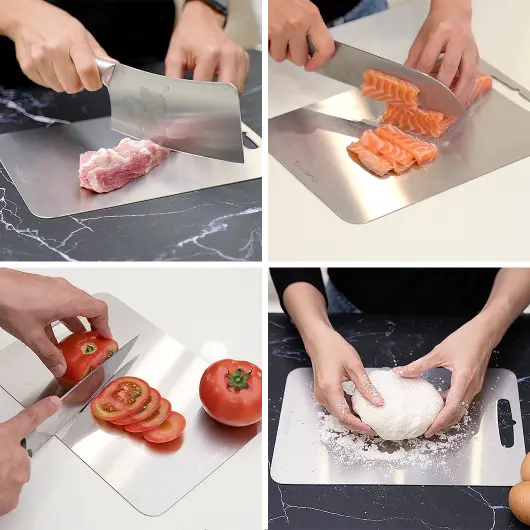
Katori is marketed as a "100% pure titanium," double-sided, antibacterial, non-porous cutting board, positioned as an upgrade from a stained wood board or a scratched-up plastic one. It's sold directly from the brand's own marketing sites rather than through major retailers. Before you buy, it's worth reading what we found about who sells it and how titanium actually compares to wood for your knives — both covered in full below.
Titanium Cutting Surface
We link to authorized retailers and may earn a commission at no extra cost to you
We're not displaying a price here. This product is sold across at least six different "official"-branded domains we identified, each running its own pricing and promotional tiers — with no single authorized source we're able to point to as reliable. See "Things worth knowing" below.
A 30-day money-back guarantee is advertised on the seller sites we checked — terms vary by which of the several domains you order from
Specs & features
What's marketed, and what we independently checked against it — including the one technical fact that most directly contradicts a headline marketing claim.
What's Marketed
Approx. 11.4" x 7.9" (29 x 20 cm)
Detail
As marketed
Material
"100% pure titanium"
Sides
Double-sided
Surface
Non-porous, antibacterial, odor- and stain-resistant
Knife claim
"Gentle on knives," "maintains blade sharpness"
Heat tolerance
Marketed as safe for hot cookware directly on the surface
Cleaning
Warm water and mild soap, hand-dry
Specs above are as published by the seller's own marketing sites. The knife-friendliness claim is addressed directly in the next section — the real hardness numbers tell a different story than "gentle on knives" suggests.
Company / operator
Not confirmed on any of the domains we checked
Domains selling this product
At least 6 separate "official"-branded sites found
Titanium hardness vs. wood
Meaningfully harder — see "What the hardness numbers actually show" below
We checked the terms/legal pages on several of these domains directly. One of them (katoricuttingboard.com) serves a "Terms" page that is boilerplate copied from an entirely unrelated product, referencing a different brand name and Netherlands law — not a page written for this product at all. We did not find a company name or registered address written specifically for Katori on any domain we checked. We're calling this "not confirmed" rather than "doesn't exist," since we can't rule out that it's disclosed somewhere we didn't find.
What the hardness numbers actually show
This is the one place where an independently checkable fact runs directly against the marketing copy — so we're spelling it out plainly rather than repeating the "gentle on knives" claim as if it were settled.
Titanium is a hard metal — wood isn't
Every source we checked agrees on the direction, even where the exact numbers differ: unalloyed titanium measures roughly 30–40 on the Rockwell hardness scale, and most kitchen knife steel runs considerably harder still (roughly 54–67 HRC depending on the blade). Wood doesn't have a standard Rockwell rating at all — it's normally measured on the separate Janka hardness scale — but multiple independent kitchen-gear and knife-care sites we checked describe titanium as meaningfully, measurably harder than wood by any comparison method. That's a real physical difference, not a marketing spin.
What that means for your knife edge
A harder cutting surface is tougher on a knife's edge, full stop — that's basic knife-care physics, and it's why professional kitchens still favor end-grain wood and soft plastic boards over hard countertop materials. Several independent test write-ups we reviewed found knives lost noticeably more edge sharpness on titanium boards than on wood or plastic over an identical number of cuts, and separately reported that knife sharpeners see clients with titanium or stainless boards return for resharpening several times more often than wood-board users. The exact percentages varied by source and none of the ones we found cite a peer-reviewed lab study — but every source we checked, including ones written to sell titanium boards, pointed the same direction: titanium is harder on your knife edge than wood, not gentler.
Titanium vs. plastic
The comparison isn't one-sided against titanium, to be fair to it: those same write-ups generally rated titanium as easier on knife edges than hard plastic boards, even while rating it worse than wood. So the honest ranking most sources converge on is wood gentlest, titanium in the middle, low-grade hard plastic worst — not the "upgrade from wood" framing the marketing copy uses.
Things worth knowing before you decide
Who's actually behind it
We found this exact product sold across at least six differently-named "official"-branded domains (for example katoricuttingboard.net, us-katori.com, katoricuttingboard.com, katoriboards.com, buykatori.online, and katori-cuttingboard.com) — a multi-domain pattern more typical of a direct-response funnel than a single retailer with one storefront.
We did not find a company name or registered business address written specifically for this product on any of the domains we checked. One domain's own "Terms" page is boilerplate lifted from an unrelated product and brand — evidence the legal page wasn't written for this product at all, not just an omission.
How it's being promoted online
Several "review" articles for this product that we found are hosted on generic Amazon S3 storage buckets (for example thejournalhub.s3.amazonaws.com and bfs-assets.s3.amazonaws.com — we found several more) with clickbait-style titles and random alphanumeric URL suffixes, rather than being published on a named news outlet or review site with a byline. That pattern reads as programmatic advertorial content built to look like independent coverage, not journalism we'd treat as a neutral third-party opinion — worth knowing when you come across one in a search result.
Prefer a board that's actually gentler on your knives?
The hardness data above shows titanium is harder on knife edges than wood, not gentler, whatever the marketing says. John Boos R-Board Series 20"x15" Reversible Maple Cutting Board is a real, established-brand alternative directly responsive to that finding — American-made end-grain-style maple, from a company that's manufactured wood cutting boards since 1887 and is a long-standing choice among professional chefs precisely because wood is genuinely gentler on a blade's edge than a hard metal surface.
This is a live Amazon link, not a specific listing we curate or control — price, availability, and exact packaging can change on Amazon's end at any time.
As an Amazon Associate I earn from qualifying purchases.
Frequently asked questions
Is titanium really gentler on knives than wood?
No — the independently checkable physics point the other way. Titanium is a considerably harder material than wood by any hardness scale we found used for the comparison, and multiple independent kitchen-gear and knife-care write-ups report knives needing more frequent resharpening on titanium boards than on wood ones. The exact percentages differ by source and none cite a peer-reviewed lab study, but the direction is consistent everywhere we checked: wood is gentler on your blade's edge than titanium, not the other way around.
Who makes the Katori board?
We couldn't confirm this. None of the six-plus "official" domains we checked name a company or registered address written specifically for this product, and one domain's own legal-terms page is boilerplate copied from an unrelated brand. We're stating this as "not confirmed" rather than claiming no company exists — we simply couldn't find one.
Why does the same product show up on so many different websites?
We found this board sold under near-identical branding across at least six separate domains. That pattern is typical of a direct-response, multi-domain sales funnel — often used to run different pricing, ad creative, or promotions per domain, or to keep selling if one domain gets flagged — rather than a single retailer operating one storefront.
Are the "review" articles about this product independent?
Several we found are hosted on generic Amazon S3 storage buckets under clickbait titles with random alphanumeric URL codes, not published by a named outlet with a byline — a pattern consistent with paid programmatic advertorial content rather than independent product journalism. Treat those the same way you'd treat an ad, not a neutral review.
Scientific references
The hardness and knife-wear sources behind the claims above — clickable, so you can read the original material yourself. None of these are peer-reviewed lab studies; they're independent kitchen-gear and knife-care publications, which is exactly why we've described the direction of the finding rather than asserting one precise percentage as fact.
Are Titanium Cutting Boards Bad for Knives? Tested and Explained. Independent knife-care hardness and edge-retention comparison, including Rockwell hardness figures for titanium and knife steel. CalmChop →
Do Titanium Cutting Boards Dull Knives? Rockwell hardness comparison of titanium, knife steel, and end-grain wood; resharpening-frequency findings. Koppenhouse →
Do Titanium Cutting Boards Dull Knives? Expert Answer. Standardized 100-cut edge-retention comparison across titanium, wood, and plastic boards. Kitchepicks →
Want more product research like this?
Get an email when we publish new reviews, supplement-market news, and occasional offers on products we cover.
Living Well Reports is operated by Aurora Group Platforms LLC. Address: 30 N Gould Street, Sheridan, Wyoming 82801, United States · [email protected]
These statements have not been evaluated by the Food and Drug Administration. These products are not intended to diagnose, treat, cure, or prevent any disease. Results may vary. Consult a healthcare professional before use.
We use cookies for essential site function and, with your consent, for advertising measurement via Microsoft Advertising. See our Cookie Policy for details, or manage your choice anytime.