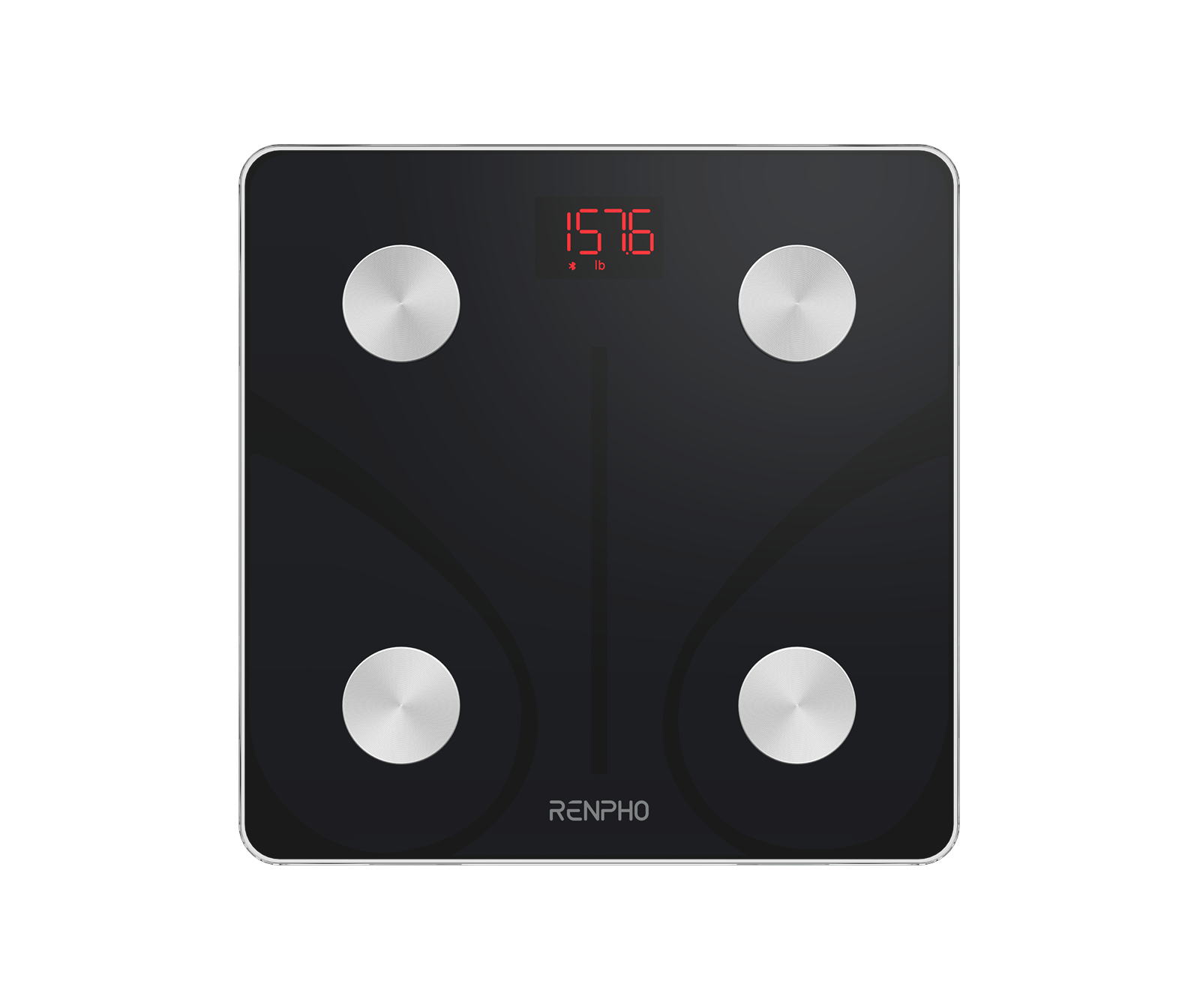

A Bluetooth bathroom scale that estimates body weight plus 13 body-composition metrics — including BMI, body fat %, body water %, and muscle mass — using bioelectrical impedance analysis (BIA). Readings sync automatically to the RENPHO Health app. RENPHO is an established brand in this category: the Elis 1 is one of its best-selling scales, with a large base of Amazon customer reviews.
We link to authorized retailers and may earn a commission at no extra cost to youAs an Amazon Associate I earn from qualifying purchases.
We don't display a fixed price here since Amazon pricing changes — click through to see the current price before buying. RENPHO also sells newer, higher-tier scales (Elis 2X, Elis Nova, and others) with more electrodes and more tracked metrics — make sure the listing you buy is the Elis 1 specifically if that's the model you want.
Full technical specifications as published on RENPHO's own product page for the Elis 1 — nothing added, nothing hidden.
| Specification | Detail |
|---|---|
| Metrics tracked | 13 (weight, BMI, body fat %, body water %, skeletal muscle, fat-free body weight, muscle mass, bone mass, protein, BMR, subcutaneous fat, visceral fat, metabolic age) |
| Sensors | 4 BIA (bioelectrical impedance) electrodes |
| Max capacity | 400 lb / 180 kg |
| Measurement range | 6.6 lb to 400 lb |
| Display | LED digital display, lb/kg units |
| Power | 3 AAA batteries (included) |
| Battery life | Up to 4.5 months (manufacturer-stated, typical use) |
| Connectivity | Bluetooth, RENPHO Health app |
| App system requirements | iOS 12+ or Android 7.0+ |
| User profiles | Unlimited, with automatic user recognition |
What bioelectrical impedance analysis actually measures, and how accurate it really is — not a claim about what this specific unit will do for you.
When you step on barefoot, the four metal sensors send a low, imperceptible electrical current up through one leg, across the pelvis, and back down through the other leg. Muscle tissue has a high water content and conducts that current easily; fat tissue has lower water content and resists it more. The scale measures how much resistance the current meets, then combines that resistance reading with the height, age, sex, and weight you've entered in the RENPHO app to estimate body fat percentage, muscle mass, water percentage, and the other tracked metrics. This is standard consumer BIA technology, not unique to this scale — the same underlying principle is used across the smart-scale category.
A peer-reviewed comparison of consumer BIA devices against DEXA and whole-body MRI (Bosy-Westphal et al., Obesity Facts, 2008) found that foot-to-foot BIA scales like this one have noticeably wider margins of error for body-fat percentage than clinical-grade hand-to-foot devices — the study reported 95% limits of agreement as wide as roughly ±14 percentage points of fat mass for some bipolar (foot-only) devices, versus a narrower range for tetrapolar (hand-and-foot) instruments. That study didn't test this specific product, and BIA hardware has improved since 2008, but the underlying physics hasn't changed: a single reading from any foot-only BIA scale is an estimate, not a lab-grade measurement, and it's also sensitive to hydration level, recent food or water intake, and time of day. The more reliable use case is tracking your own trend over weeks — weighing in at a consistent time of day, under similar hydration conditions — rather than treating any single session's body-fat number as exact.
The study below backs the accuracy note above — clickable, so you can read the original source yourself rather than take our summary on faith.
For total body weight, yes — that measurement is straightforward and reliable on any decent scale. For body-composition metrics like body fat %, no: consumer foot-to-foot BIA scales (this one included) have a wider margin of error than clinical tools like DEXA scans, per the research cited above. They're best used to track your own trend over time under consistent conditions, not as a precise, one-time clinical reading.
Yes. Because BIA works by measuring electrical resistance through body water, anything that changes your hydration — a workout, a large meal, alcohol, or just the time of day — can shift the body-composition numbers even if your actual body fat hasn't changed. Weighing in at a consistent time (e.g., first thing in the morning) gives more comparable trend data than weighing in randomly.
The app is required to see the 12 body-composition metrics beyond weight — the scale itself only displays a number on its LED screen. RENPHO's own product page lists the Elis 1 as compatible with Apple Health, Fitbit, Samsung Health, and MyFitnessPal; that's the manufacturer's stated compatibility, and we haven't personally tested each integration ourselves.
Yes — per RENPHO, the app supports unlimited user profiles with automatic recognition, so it's built to be shared rather than tied to one person's data.
Get an email when we publish new reviews, supplement-market news, and occasional offers on products we cover.