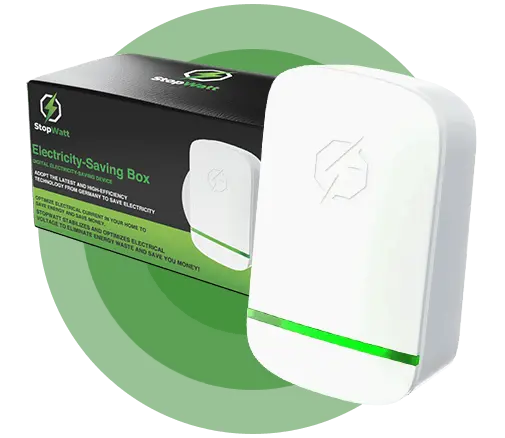
StopWatt is a small home & energy gadget that plugs directly into a wall outlet. The manufacturer markets it as a whole-home "electricity stabilizer," describing it as a way to reduce electrical noise and improve power quality throughout a home's wiring — with no appliance changes and nothing to install beyond plugging it in.
Power Line Filter
We link to authorized retailers and may earn a commission at no extra cost to you
We're not displaying a price for StopWatt on this page, and this listing doesn't link to a StopWatt checkout. The seller's own site shows a clock-style discount banner claiming the price "expires at midnight" — reloading the page shows the same message again, which reads as a static urgency device rather than a real, one-time deadline. Combined with the gaps noted below, we don't think we can present a price here responsibly. This listing is informational only.
Specs & features
What the manufacturer states about StopWatt, transcribed as claims — plus what we looked for and could not find, including basic company information that's normally the easiest thing to locate.
What the manufacturer states
Category: Home & energy gadget
Marketing claim
Status
"Stabilizes electrical current"
Manufacturer claim, not independently verified
"Reduces dirty electricity"
Manufacturer claim, not independently verified
"On-the-spot reactive power compensation"
Manufacturer claim, not independently verified
"Absorbs harmonic waves"
Manufacturer claim, not independently verified
Helps "dramatically lower energy consumption"
Manufacturer claim, not independently verified
"Approved to work in all 50 states"
No approving body named
Claims transcribed from the manufacturer's own marketing site. We're reporting them here as claims, not repeating them as established fact.
Manufacturer / company name
Not disclosed anywhere on the seller's site
Company address
Not disclosed anywhere on the seller's site
Independent testing
None found — no non-manufacturer test data located
A technical note worth knowing: based on the mechanism the manufacturer describes — reactive-power compensation and harmonic filtering — this class of plug-in device is generally a small power-factor-correction capacitor, a real and established piece of electrical engineering. It's genuinely useful for large industrial or commercial sites with heavy motor loads. Residential electric meters in the US, though, almost universally bill for real power (kWh) rather than reactive power, meaning this category of device typically has little to no effect on a home electric bill regardless of how well it filters electrical noise. This is a general point about how this class of device and mechanism works, not a claim about what's specifically inside this unit.
Things worth knowing before you decide
Real gaps, stated plainly
No company name or address disclosed anywhere on the manufacturer's own site.
No independent, non-manufacturer testing of StopWatt found anywhere.
The "approved to work in all 50 states" claim doesn't name which body issued that approval.
Customer testimonials on the seller's site cite specific dollar-amount savings (for example, "saved $35") without describing how those savings were measured.
The marketing itself
The checkout page displays a clock-style discount banner claiming the price "expires at midnight." Reloading the page shows the same banner again, unchanged — a static urgency device rather than a real, ticking clock toward an actual deadline. Combined with the missing company information above, we treat the pricing on this listing as unreliable, which is why we're not showing it on this page.
Prefer a device that actually measures your electricity use?
StopWatt claims to lower energy consumption but doesn't publish independent test data, or even a company name. If you'd rather know exactly what your appliances are using — in real kWh, not a marketing claim — the P3 International Kill A Watt Electricity Usage Monitor is a real alternative worth knowing about: you plug it into the wall, plug your appliance into it, and it directly measures kilowatt-hours consumed, voltage, amps, and frequency over a period you set, then shows real cost based on your own electricity rate. It doesn't claim to save you power — it just reports what you're actually using. P3 International has sold consumer electricity-usage meters since the original Kill A Watt launched in the mid-2000s, and this category of meter is commonly referenced by US utility efficiency programs as a way to measure real household plug loads.
This is a live Amazon link, not a specific listing we curate or control — price, availability, and exact packaging can change on Amazon's end at any time.
As an Amazon Associate I earn from qualifying purchases.
Frequently asked questions
Will StopWatt lower my electric bill?
We can't confirm that it will. Based on the mechanism the manufacturer describes, this class of device mainly addresses reactive power and electrical noise — factors that matter most for heavy industrial motor loads. Residential electric meters in the US generally bill for real power (kWh), not reactive power, so this category of device typically has little effect on a home's bill regardless of how well it filters noise. We found no independent test data on StopWatt specifically that would confirm otherwise.
What does "approved to work in all 50 states" mean?
The manufacturer's site uses that phrase without saying which body granted the approval. Electrical devices sold in the US are commonly expected to carry a recognized safety certification, such as UL or ETL — StopWatt's marketing doesn't cite one, so we can't tell you what "approved" refers to here.
Why doesn't this page show a price or a buy link?
The seller's checkout page displays a discount banner that resets to the same "expires at midnight" message on every visit, rather than counting down to a real deadline, and the site discloses no company name or address anywhere we could find. Given those two gaps, we don't think we can present a price here responsibly — this listing is informational only, with no link to a StopWatt checkout.
Who makes StopWatt?
We weren't able to find a company name or address anywhere on the manufacturer's own marketing site. We're stating that gap plainly rather than guessing at an answer.
Scientific references
The source below backs the regulatory note above — clickable, so you can read it yourself rather than take our summary on faith.
Federal Trade Commission. Notice of Penalty Offenses Concerning Energy Savings Claims — first issued 1979, building on the FTC's earlier determination in In re Certified Building Products, Inc., 83 F.T.C. 1004 (1973). States that it is "an unfair or deceptive act or practice" to represent that a product will result in energy savings that consumers won't ordinarily realize. FTC.gov →
Living Well Reports is operated by Aurora Group Platforms LLC. Address: 30 N Gould Street, Sheridan, Wyoming 82801, United States · [email protected]
These statements have not been evaluated by the Food and Drug Administration. These products are not intended to diagnose, treat, cure, or prevent any disease. Results may vary. Consult a healthcare professional before use.
We use cookies for essential site function and, with your consent, for advertising measurement via Microsoft Advertising. See our Cookie Policy for details, or manage your choice anytime.