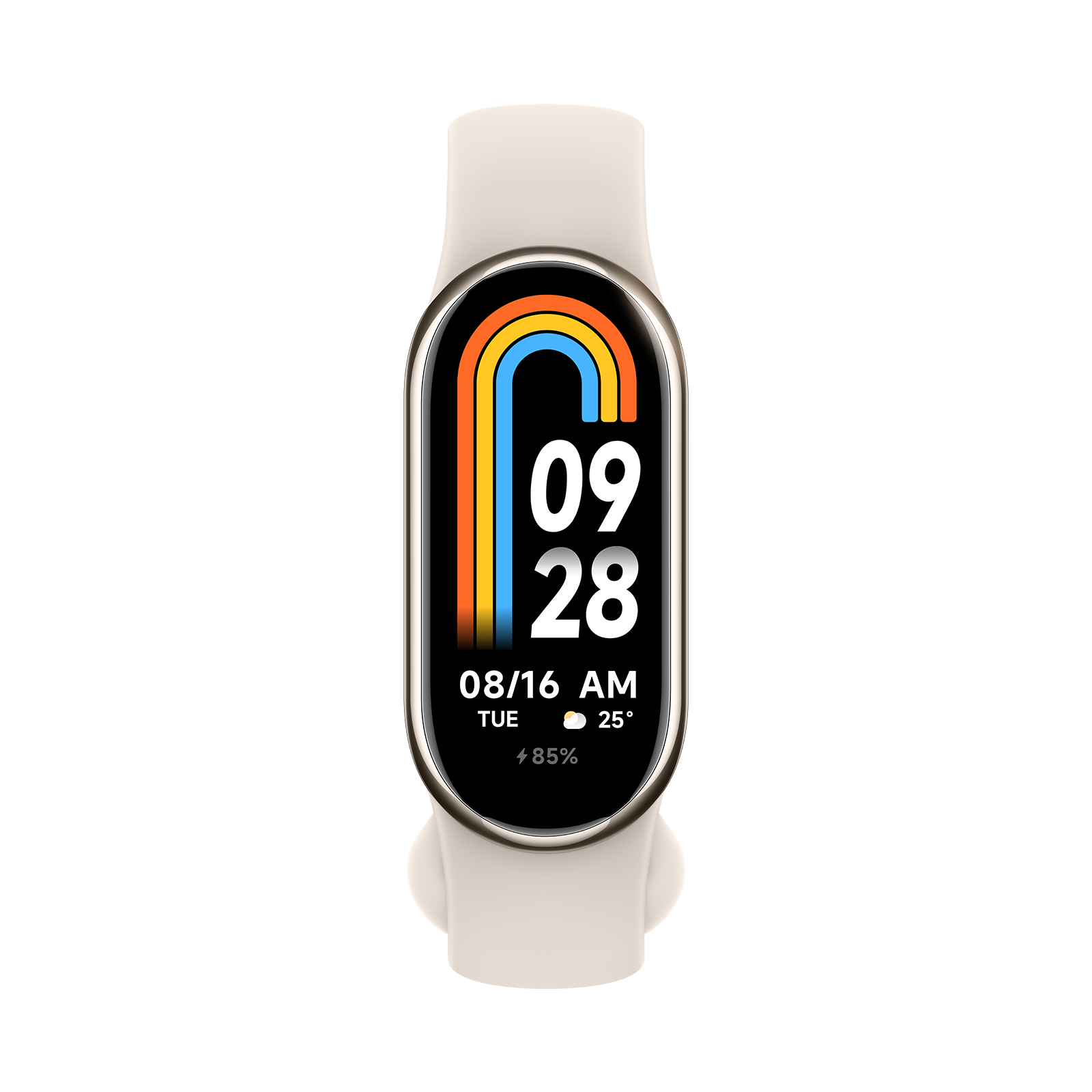

A slim fitness and health tracker wristband (Global Version) with a 1.62" AMOLED touchscreen, 150+ sports modes, and optical sensors for heart rate, blood oxygen (SpO2), sleep, and stress monitoring. Rated by Xiaomi for up to 16 days of battery life on a single charge. Syncs to the Mi Fitness app over Bluetooth. Xiaomi's Mi/Redmi Band line is one of the best-selling fitness-tracker families worldwide.
We link to authorized retailers and may earn a commission at no extra cost to youAs an Amazon Associate I earn from qualifying purchases.
We don't display a fixed price here since Amazon pricing changes — click through to see the current price before buying. This is the Global Version, which ships with a multi-language interface (including English) — a separate China/CN version exists with different default language and app pairing, so check the listing carefully before buying.
Full technical specifications as published on Xiaomi's own global product/specs pages — nothing added, nothing hidden.
| Specification | Detail |
|---|---|
| Display | 1.62" AMOLED touchscreen, 60Hz refresh rate |
| Battery capacity | 190mAh |
| Battery life | Up to 16 days typical use (manufacturer-stated) |
| Charging | Magnetic charging cradle, ~1 hour full charge |
| Sports modes | 150+ |
| Health sensors | Optical heart-rate sensor, SpO2 (blood oxygen) sensor, sleep monitoring, stress monitoring |
| Water resistance | 5 ATM |
| Connectivity | Bluetooth 5.1 BLE, Mi Fitness app |
| Phone compatibility | Android 6.0+ or iOS 12.0+ |
What the optical sensors actually measure, and how accurate they really are — not a claim about what this specific unit will do for you.
Like nearly all consumer fitness bands, the Mi Smart Band 8 measures heart rate and blood oxygen using PPG (photoplethysmography) — LEDs on the underside of the band shine light into the skin, and a photodetector measures how much light is absorbed and reflected as blood volume changes with each heartbeat. Blood oxygen saturation is estimated from how differently oxygenated versus deoxygenated blood absorbs different wavelengths of light. This is the same basic technology used in the SpO2 finger clips found in medical settings, but implemented with a smaller, wrist-worn, lower-cost optical sensor rather than a purpose-built clinical instrument — and Xiaomi's own materials state plainly that this device is not a medical device and its readings are for informational purposes only.
Peer-reviewed validation research on the Xiaomi Mi Band lineage gives a mixed picture. A 2022 study in Annals of Rehabilitation Medicine compared the Mi Band 5 to ECG in cardiac patients during exercise testing and found strong correlation (rc > 0.90) with ECG at rest and low-intensity exercise, but reported all tested consumer bands became less accurate during moderate-to-high-intensity effort. A 2026 study in Sensors testing the Mi Band 6's SpO2 and heart-rate readings against a clinical pulse oximeter in children and adolescents with severe cerebral palsy found heart rate had good reliability (ICC 0.83) for general monitoring, but SpO2 readings had low reliability (ICC 0.55) and error margins that exceeded clinically acceptable accuracy — the authors concluded the device was "not suitable for assessing SpO2" in that population. Neither study tested the Smart Band 8 specifically, and the cerebral-palsy study is a narrow clinical population that may not generalize to healthy adult wrist-band use — but taken together, the evidence supports treating this band's heart-rate readings as reasonably useful for general activity tracking at rest and moderate effort, and its SpO2 readings as directionally informative at best, not a substitute for a real pulse oximeter.
The studies below back the accuracy notes above — clickable, so you can read the original source yourself rather than take our summary on faith.
No. Xiaomi's own support materials describe the band as not a medical device, with health readings intended for informational purposes only, not diagnosis or treatment. Validation research on the Mi Band lineage (see Scientific references above) has found SpO2 readings noticeably less reliable than a clinical pulse oximeter, particularly outside of resting, stable conditions. Treat the SpO2 number as a rough, directional data point, not a clinical measurement.
Research on this device family shows the strongest agreement with ECG at rest and during low-to-moderate intensity exercise, with accuracy dropping off at higher intensities — a pattern common to virtually all optical wrist-based heart-rate sensors, not unique to this product. It's reasonable for general activity and cardio tracking; it's not a substitute for a chest-strap monitor or clinical ECG if you need precise numbers during intense training.
Xiaomi rates it at up to 16 days under typical use. Actual runtime will be shorter with heavier use of the always-on display, GPS-connected workouts, frequent notifications, or continuous SpO2/heart-rate tracking — none of which we've independently benchmarked ourselves.
Yes — per Xiaomi's published specs, it's compatible with iOS 12.0 or later, as well as Android 6.0 or later, via the Mi Fitness app over Bluetooth 5.1.
Get an email when we publish new reviews, supplement-market news, and occasional offers on products we cover.